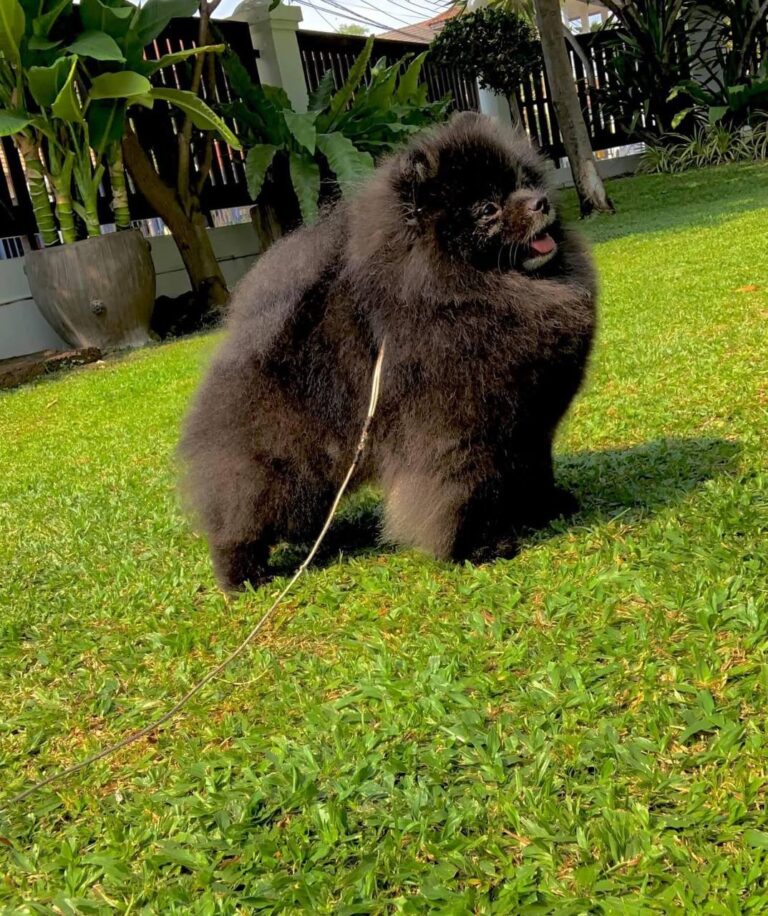
Pomeranian characteristics: size, coat and temperament
The Pomeranian is the smallest German Spitz. It stands about 17–24 cm (6.7–9.5 in) tall, with a thick, fluffy double coat around the neck, a pointed fox-like face, a quick mind and a strong habit of barking to raise the alarm. At our kennel we select for a short face (the “baby face” look), a dense coat and small size. If you visit, you can see every trait in this article on the parents of our puppies.
Bánh Bò Pomeranian is a Pomeranian kennel in Ho Chi Minh City, Vietnam. We have bred since 2012, when we started out as Cải Bắp Kennel. We breed to the FCI standard, belong to the Vietnam Kennel Association (VKA) and export Poms to the USA and Canada. This article compares the FCI standard with the Pomeranian breed profile from Hill’s Pet. Then we add the problems owners in Vietnam often run into, which foreign sources rarely mention.
How tall and heavy is an adult Pomeranian?
Under FCI standard No. 97, the Pomeranian measures 21 cm ± 3 cm (8.3 in ± 1.2 in) at the shoulder, or about 18–24 cm (7–9.5 in). The FCI sets no fixed weight. It only asks that weight be in proportion to height. The Hill’s Pet breed profile gives a range of 3–7 pounds, about 1.4–3.2 kg.
Poms grow fast. According to Hill’s Pet, they usually reach adult size at around 7–10 months of age.
The correct Pom outline is square: height at the shoulder equals body length, a 1:1 ratio under the FCI standard. The muzzle is shorter too. The standard puts the Pomeranian’s muzzle-to-skull ratio at about 2:4, compared with about 2:3 for the larger Spitz sizes. That is why a Pom’s face looks rounder and more compact than the faces of its bigger relatives.
You will often hear labels like “teacup,” “mini” or “micro.” These are marketing names. None of them is a size class in the FCI standard, and nobody can promise exactly how tall a puppy will end up. Seeing the puppy’s parents in person is the most reasonable guide.

What makes the Pom’s coat and colors special?
A Pom has a double coat. The undercoat is short, dense and soft as cotton, and it lies close to the skin. Over it grows a long, straight outer coat that stands off the body. Together the two layers create the thick ruff around the neck and the plumed tail that curls right over the back, the look of a breed with cold-climate roots.
Coat colors vary widely. Orange is the color most people link with the breed. You will also see cream, white, black, chocolate brown, sable (hairs tipped with a darker color) and many mixes of these colors.

How did the Pom become so small?
Poms were not always small. The breed descends from Spitz dogs of Pomerania, a region on the Baltic coast that now belongs to Germany and Poland, and those dogs were much heavier than today’s Pom. The name Pomeranian comes from that region.

When the breed reached England, Queen Victoria became very fond of it. From her dogs and those of other breeders of the time, people gradually selected smaller dogs with brighter coat colors in place of the white and gray common in the old Spitz. From the start, the Pom was a companion dog that stayed close to people. It also guarded the house with its bark.
Photos of Poms from around 1900 show a body shape and coat that differ from the Pom you see today. Breeders kept selecting after that era.

Is the Pomeranian temperament a good fit for houses and apartments?
Yes, as long as you teach your puppy to bark less from an early age. Poms are alert, react quickly to unfamiliar sounds and bark a lot to sound the alarm. In a house, that makes your Pom a good “doorbell.” In an apartment with thin walls, the same barking can easily bother the neighbors if you do not start training the day your puppy comes home.
A Pom has no idea it is small. Your puppy may bark right in the face of a dog ten times its size. When you walk in a park or down an alley where big dogs roam off leash, keep your Pom on the leash and pick it up when needed.
This is a smart breed that enjoys learning and loves praise. Your Pom still needs exercise every day, even if it is only one walk around the block. A Pom that gets regular play and training usually destroys fewer things and barks less at small stuff than one shut in all day. Older Poms grow even fonder of your lap.

How do you care for a Pom’s double coat in hot, humid weather?
Regular brushing and thorough drying matter most. The Hill’s Pet breed profile recommends brushing 1–2 times a week, and every day during shedding season. In Vietnam, high humidity keeps the undercoat damp longer and makes it mat easily, so steady brushing is even more necessary here.
After a bath, dry your Pom all the way down to the undercoat next to the skin, not just the outer coat. A damp undercoat combined with hot weather is an ideal setting for fungal infections and skin inflammation. If you see red skin, patchy hair loss or constant scratching, take your Pom to the vet. Do not apply any medication on your own.
Many owners shave their Pom down in hot weather, hoping to keep it cool. We do not recommend it. The double coat shields the skin from the sun, and some Pomeranians grow their coat back slowly or unevenly after a close shave. Trimming is fine, but leave the undercoat in place.
Walk your Pom in the early morning or evening. Skip the midday sun, and never leave your dog in a car or a closed room without a fan. Small dogs with thick coats overheat easily. Watch for these signs of heatstroke:
- Heavy, intense panting that does not ease once your Pom is in a cool spot
- Dark red gums and tongue, with a lot of drooling
- Lethargy, wobbly walking, vomiting or diarrhea
If you see any of these signs, take your Pom to a veterinary clinic right away. On the way, you can cool your dog with a towel soaked in cool water (not ice water) and let it lie where air moves freely. This only helps during the trip. It does not replace an exam.
Which families are a good match for a Pom?
Poms suit older adults and families whose children are old enough to be gentle. A Pom is small and sensitive and sticks close to its owner, so it makes good company for grandparents who spend a lot of time at home. With young kids, explain that a Pom is far less sturdy than a big dog. Picking it up the wrong way can hurt it. So can a drop. An adult should sit nearby while children play with the puppy.

Poms usually get along with other pets. If you have a large dog, supervise them together, because a big dog can injure a Pom by accident with a single playful pounce. A Pom raised with children tends to be friendly with them. One that has not been around kids may be wary at first.
Hill’s Pet lists a lifespan of about 12–16 years. Bringing a Pom home means committing to more than a decade of care, through moves, new babies and jobs that take you far from home.
Would you like to see a short-faced, thick-coated Pom up close, or are you looking for a puppy to bring home? Just chat with us on WhatsApp. Our kennel is at 52 Lê Lai, Bảy Hiền Ward, Ho Chi Minh City, and we welcome visitors by appointment only.
Medical information in this article was reviewed by veterinarians at Home Pet Veterinary Clinic on October 10, 2026.