AKC Pomeranian Breed Standard: Everything You Need to Know When Choosing a Quality Pom
When you decide to bring a Pomeranian home, the first question you need to answer isn’t “which puppy is the cutest” but “which puppy is correct to standard.” A quality Pom isn’t just pretty — it must be RIGHT: correct bone structure, correct body proportions, correct coat texture, correct temperament. That’s why international kennel organizations like the AKC (United States), FCI (Europe) and VKA (Vietnam) all publish detailed Pomeranian breed standards that clearly define what characteristics a proper Pom must have.
At Bánh Bò Pomeranian in Ho Chi Minh City, we’ve been working with VKA/FCI pedigreed lines since 2012, and over a decade with this breed has taught us one thing: the breed standard isn’t “dry paperwork” — it’s the compass for choosing a healthy, balanced, long-lived and happy dog. This article will help you understand every important criterion, from ideal weight to head shape, leg structure, recognized coat colors, and even serious disqualifying faults.

Ideal Weight and Size for a Standard Pomeranian
According to the AKC standard, the correct weight for an adult Pom ranges from 3–7 pounds (approximately 1.4–3.2 kg), with the ideal show weight being 4–6 pounds (1.8–2.7 kg). The FCI standard focuses on height: 21 cm (8.3 inches) at the withers, allowing a margin of ±3 cm (18–24 cm or 7–9.4 inches). Both approaches aim for the same thing: Pomeranians are a toy breed, but they must be sturdy, not fragile.
Body proportion is equally important. A standard Pomeranian has a square outline: the ratio of body length (from point of shoulder to point of buttocks) to height at withers is 1:1. This is the clearest distinction from many other small breeds that have long bodies. Viewed from the side, a proper Pom looks like a neat little square, not stretched or compressed.
In Vietnam, many owners hear terms like “mini Pom,” “teacup Pom” or “pocket Pom.” In reality, these names don’t appear in any official standard. There is only one Pomeranian breed. Dogs that are too small (under 1.4 kg or 3 lb as adults) often face serious health issues: fragile bones, hypoglycemia, difficult whelping. Conversely, a dog over 3.5 kg (7.7 lb) that is still balanced, healthy and has clear pedigree is still a purebred Pom — just not suitable for show competition.
Head, Muzzle and Characteristic Expression
The Pom’s head must be in proportion to the body, wedge-shaped when viewed from above — broad at the back and tapering toward the nose. The skull is slightly rounded but not domed like an apple (apple head is a serious fault). The stop (transition from forehead to muzzle) must be well-defined.

The muzzle is short, straight, neither long and pointed nor coarse. The ideal ratio between muzzle length and skull is 1:3 to 2:3 — meaning the muzzle occupies about one-third to two-thirds of the head length. This is the “short baby face” characteristic that Bánh Bò Pom has specialized in for over a decade. A short muzzle gives the Pom a youthful, adorable look, but it must be long enough to avoid breathing difficulties.
Eyes are dark, bright, medium-sized, almond-shaped, set fairly deep into the skull. The distance between the eyes is balanced with other facial features. Eye rims are black, except in chocolate, beaver or blue dogs where rims match the coat color. Ears are small, set high and always erect — dropped or semi-erect ears are a serious disqualifying fault in the show ring.
The overall expression of a Pomeranian is often described as “fox-like” — showing intelligence, curiosity and alertness. This isn’t just appearance but temperament: a proper Pom is always alert, confident, neither shy nor aggressive.

Body Structure: Back, Chest, Legs and Tail
The neck must be long enough to allow the head to be carried high and proud — a sign of a confident Pom. The topline is level from withers to croup, not sagging or arched. The back is short, firm and straight. The chest is oval-shaped, extending to the elbows, with a prominent forechest. The loin is short and slightly arched. The croup is flat.
The tail is one of the Pom’s most distinctive features. It must be set high, heavily plumed, lying flat and straight over the back. A low-set tail is a major fault. When standing, the tail forms a beautiful arc, contributing to the characteristic “powder puff” silhouette of the Pomeranian.
Forelegs viewed from the front must be straight, parallel, evenly spaced, placed well under the chest. Shoulders are well laid back, shoulder blade and upper arm equal in length. Elbows are close to the body, not turned in or out. Pasterns are straight and strong — weak, down-in-pastern is a serious fault.
Hindquarters are balanced with forequarters in angulation. The buttocks are well behind the set of the tail. Thighs are moderately muscled, upper and lower thigh equal in length. Stifles are well-bent, clearly defined. Viewed from behind, the legs are straight and parallel. Hocks are perpendicular to the ground when viewed from the side. Cow hocks, in or out at the knees, or any unsoundness in legs or stifles are major faults.
Feet are small, round, compact and cat-like, with well-arched toes, not turning in or out, standing well up on toes. Dewclaws may be removed.
The Distinctive Double Coat: Undercoat and Guard Hair

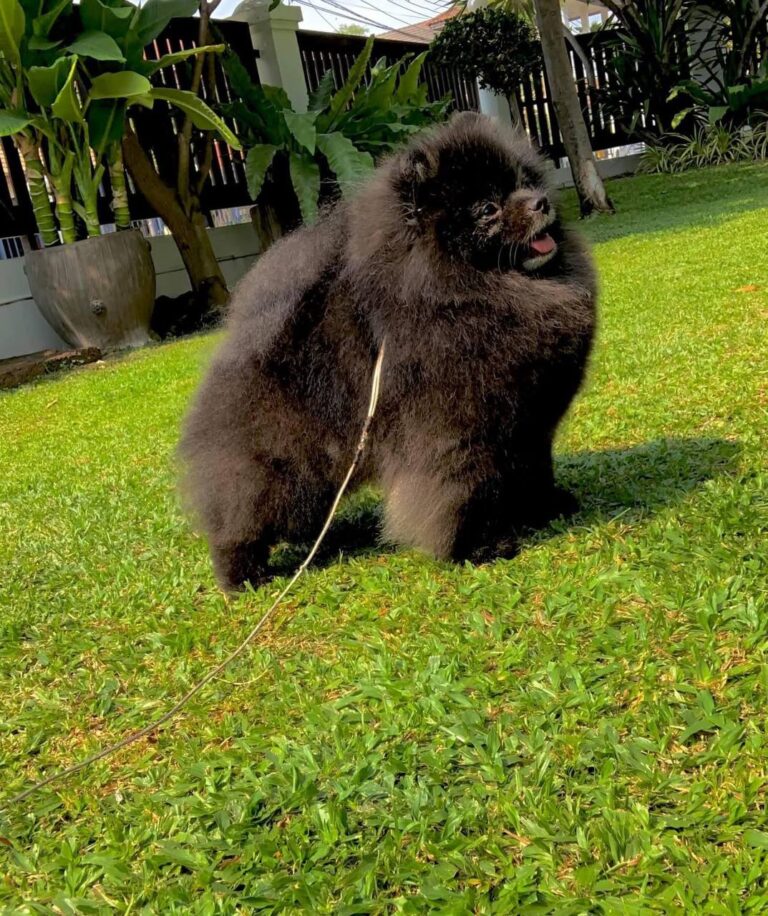
This is one of the most important characteristics for identifying a standard Pomeranian. Poms have a double coat: a short, dense, soft undercoat that supports the longer, harsher, straight outer coat (guard hair). The guard hair grows through the undercoat, creating the stand-off appearance from the body.
The coat around the neck forms a thick ruff framing the head, extending over the shoulders and chest. Hair on the head and legs is shorter and tighter than on the body. Forelegs are well-feathered. Thighs and hind legs are heavily coated down to the hocks, forming a “skirt.” The tail is profusely covered with long, harsh, spreading hair forming a plume.
Females may not carry as thick or long a coat as males — this is normal due to hormonal influences from reproductive cycles. Puppies may have a thicker, shorter overall undercoat with less developed guard hair. A cotton coat in adult dogs is undesirable. A soft, flat or open coat is a major fault.
Trimming for neatness and a clean outline is permitted, but never shave or over-style. In Vietnam’s hot, humid climate, many Pom owners worry and want to cut the coat short to keep their dog cool. However, the double coat actually provides insulation — protecting the skin from sun and maintaining stable body temperature. Cutting too short can permanently damage coat structure, causing uneven regrowth or loss of the natural stand-off quality.

Recognized Colors and Patterns
A special point in the Pomeranian breed standard: all colors, patterns and variations are acceptable and must be judged on an equal basis. No color is “superior” to another in terms of standard. However, in actual show competition, orange and red are most commonly seen in the ring.
Recognized colors and patterns include:
- Solid colors: black, brown, gray, orange, orange sable, cream, cream sable.
- Brindle: dark cross stripes on a solid or allowed pattern background.
- Parti: white base with any solid color or allowed pattern. Blaze on head preferred. Ticking is undesirable.
- Extreme Piebald: white with color patches on head and base of tail.
- Piebald: white with color patches on head, body and base of tail.
- Irish: color on head and body, white legs, chest and collar.
- Tan Points: any solid color or pattern with clearly defined tan markings above each eye, inside ears, on muzzle, throat, forechest, all legs and feet, underside of tail and skirt. The richer the tan the better.
Major fault: pronounced white on the entire foot or on one or more feet (except white or parti) on any accepted color or pattern.
In specialty shows in the United States, the Open class is often divided by color: Open Red, Orange, Cream and Sable; Open Black, Brown and Blue; Open Any Other Color, Pattern or Variation.
Correct Gait and Temperament
The Pomeranian’s gait must show good reach in front and strong drive from the rear, creating efficient movement that covers ground without ever looking inefficient or busy. The head is carried high and proud with the overall topline maintained. Movement is smooth, free, balanced and vigorous.

When viewed from front and rear while walking or trotting slowly, the Pomeranian should move in a “double track” (two parallel footprints), but as speed increases, the legs converge slightly toward the center line. Front and rear legs move straight forward, with no elbows or stifles turning in or out. The topline must remain firm and level with overall balance maintained.
In temperament, the Pomeranian is an extroverted dog exhibiting great intelligence and a vivacious spirit, making it a great companion dog as well as a competitive show dog. Though a Toy breed, the Pom must be subject to the same requirements of soundness and structure as all breeds, and any deviation from the ideal described in the standard should be penalized to the extent of the deviation.

Disqualifications and Serious Faults
The breed standard doesn’t just describe what’s correct — it clearly states what’s seriously wrong enough to disqualify from showing or breeding. Understanding these faults helps you avoid purchasing a dog with genetic problems.
Absolute disqualifications according to AKC:
- Light blue eyes, blue marbled eyes, or blue flecked eyes.
Major faults:
- Round, domed, apple-headed skull.
- Undershot, overshot, or wry bite.
- Low-set tail.
- Weak, down in pasterns.
- Cow hocks, in or out at the knees, or unsoundness in legs or stifles.
- Soft, flat or open coat.
- Pronounced white on the entire foot or on one or more feet (except white or parti) on any accepted color or pattern.
According to the FCI standard, additional disqualifications include: unclosed fontanel, ears not fully erect, pronounced white patches or blazes on all non-white Poms, any color not listed in the color section, aggressive or overly shy dogs.
Why the Breed Standard Matters for Pet Owners
Many people think the breed standard only matters for those who want to compete in shows. In reality, it’s important for every owner — even if you just want a Pom as a companion at home.
The breed standard was built on hundreds of years of observation, selective breeding and veterinary medical knowledge. Every detail in it — from muzzle ratio, leg angulation, to coat structure — has a reason related to health and function. For example, a muzzle that’s too short causes breathing problems; weak legs are prone to luxation; thin coat provides poor skin protection; a low-set tail often accompanies spinal issues.
When you choose a Pomeranian from a kennel committed to breeding to FCI/VKA standards like Bánh Bò Pom, you’re not just buying a pretty puppy — you’re buying peace of mind that the dog was born from healthy parents, has balanced body structure, lower risk of inherited diseases, and stable temperament. Clear pedigree helps predict how the puppy will grow, what the coat will be like, what the personality will be — instead of “luck of the draw” when buying a dog of unknown origin.
Additionally, if you later want to participate in shows or breed responsibly, having a standard-correct dog is a prerequisite. VKA (Vietnam Kennel Association) is a member of FCI, the world’s largest dog organization, and all VKA-organized competitions apply FCI standards. VKA/FCI certification isn’t just “paperwork” — it’s proof your dog belongs to an internationally recognized bloodline.