Pomeranian origins: from large Spitz dogs to the small Pom
Where do Pomeranians come from?
Pomeranians descend from large Spitz-type dogs of northern and central Europe. English breeders later selected them smaller over many generations, producing the Pom we know today. The breed has no single homeland and no single date of origin.
Historical accounts describe the origin in several stages: the old Spitz dogs of Europe, a name taken from the region of Pomerania, and then the miniaturizing work of English breeders.
Every Pom at our kennel keeps three features from its Spitz ancestors: small erect ears, a thick double coat, and a tail curled over the back. Our line also selects for a short baby-face muzzle and a smaller size.
An engraving on an ancient Greek bronze vessel (according to the photo caption, dated to the 2nd century BCE) shows a long-haired, Spitz-type dog with a curled tail. This type of dog appeared in art long before the name Pomeranian existed.

Pom’s ancestors were large, sturdy dogs that worked alongside people, guarding homes and tending livestock. The Pom descends from this old Spitz line. It did not come from crossing two modern breeds.

Where does the name Pomeranian come from?
The name comes from Pomerania, a region on the southern shore of the Baltic Sea that is now split between northern Germany and Poland. The name does not mean every ancestor of the Pom was born there. Spitz dogs lived across northern and central Europe, and Pomerania was closely tied to them. It is believed to have helped shrink their size.
Starting in the 18th century, Swedish naturalist Carl Linnaeus used the name Canis Pomeranus. The name was familiar in Europe very early.

Each country had its own name. The French called the dog Chien de Pomeranie, Lulu or Lou-Lou. The Dutch called it Wolfshond, later renamed Keeshond. Italy has its own breed, the Volpino Italiano.

In Germany, Spitz dogs were named by size. The five names are:
- Wolfspitz (or Keeshond)
- Grossspitz (large Spitz)
- Mittelspitz (medium Spitz)
- Kleinspitz (small Spitz)
- Zwergspitz (dwarf Spitz, the Pomeranian)
According to the FCI, the Pom falls under the German Spitz standard as the smallest size in that group, and Germany is listed as the country of origin. In England, the United States, Australia and several other countries, the Pom is recognized and shown as its own Toy breed. When even smaller dogs were developed in England, the name Pomeranian was kept.
How big were Pomeranians in the past?
Pomeranians in the early 19th century stood about 18 to 20 inches (46 to 51 cm) tall, and some weighed as much as about 20 lb (9 kg). That is far bigger than an adult Pom in our kennel today.
A book by William Taplin, published in London in 1803, recorded the look of this dog: a very large ruff, small pointed ears that stood upright, a mostly black nose and eyes, and a large tail curled over the back. At the time, the English called it the fox dog because its head looked like a fox’s.

Coat colors back then were varied. Most were pale yellow or cream, some were white, a few were black, and very rare ones had markings. The Pom has never come in just one color.

A thick ruff, small upright ears, a black nose and eyes, and a tail curled over the back: these four features described in 1803 are still the defining traits of the Pom more than two centuries later.

How did the Pomeranian become small?
The Pom became smaller slowly over many generations, as breeders kept choosing smaller dogs for breeding while keeping the coat, the curled tail and the lively look. A large draft dog did not suddenly turn into a pocket-sized pet.
In 1761, Queen Charlotte married King George III and brought her dogs with her to England. These dogs were often called Pomeranians or wolf dogs, and they were bigger than the Pom in today’s show ring. Queen Victoria later kept, bred and showed Poms, which made the breed much more famous.

Poms began appearing at dog shows in England in the 1860s. In 1891, the first Pomeranian club in England was founded.

The breed standard was published in 1898 and revised in 1909. In the United States, the AKC recognized the breed in 1900.

In the early 20th century, the Toy-size Pom gradually took over the show ring, although the first standards still recognized both small and larger Poms. In historical sources on the Toy type (Zwerg-Spitz), a dog named Halliford Billy was used as an example of appearance.

A newspaper dated March 13, 1920, carried a piece titled “The Pomeranian” with a photo of Perivale Golden Bracket, owned by Mrs. Viola G. Proctor. The dog had a thick coat and a darker ruff around the neck and chest.

What do photos from 100 years ago show Poms kept?
A 1913 photo shows a fluffy black Pom standing on a sandy beach. Its shaggy, dense coat already looks like the Pom of today.

In 1915, a person holds a black Pom in front of an old brick doorway. By then, the Pom was already a companion dog kept indoors.

Another 1915 photo shows a fluffy cream dog held in arms, next to a wooden crate and a brick wall. From the early 20th century, the Pom was already a close companion to people.

In 1930, a fluffy white Pom was walked on a leash across a lawn. Walking a Pom on a leash is not a new habit.

A 1947 photo shows six dogs sitting together on a wooden platform, with black, cream and white coats. Mixed colors in one group have been normal for this breed for a long time.

The thick double coat is a legacy of the cold Baltic region. The black dog sitting on the wooden crate in the 1915 photo already had this fluffy coat.

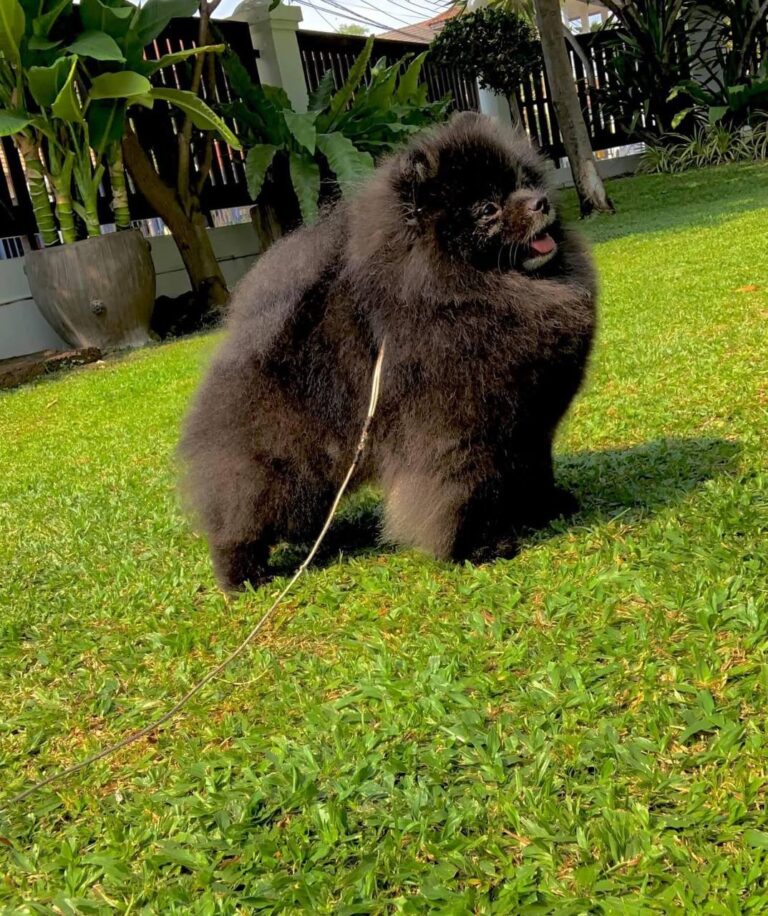
Another black dog stands in profile with its ears up. The 1803 description says the Pom’s head looked like a fox’s, while our line selects for a short baby-face muzzle. That breeding direction is specific to our kennel.

Each feature of the Pom today is the result of many generations of selection. That is why a serious breeder must keep clear pedigree records for every breeding dog.

When you choose a puppy, the parents’ FCI and VKA papers show which line your puppy comes from. All of our breeding dogs have complete papers and a clear FCI pedigree, in line with our belief that a Pom must be correct, not only beautiful.

Does the thick Pom coat suit Ho Chi Minh City’s climate?
The double coat suits cold regions, so in Ho Chi Minh City your Pom can overheat much more easily than you might think. Keep your dog in a cool, airy room and avoid walks in the midday sun. If your dog breathes fast, becomes weak, or you suspect heatstroke, take it to a veterinary clinic right away. Ask your veterinarian how to cool your dog on the way, and do not use ice. This does not replace a veterinary exam.

After a bath, dry the coat all the way down to the undercoat next to the skin. Damp fur stays wet for a long time in hot, humid weather, which can easily cause problems for your dog’s skin.

If you are looking for a Pom and want to ask about the puppies in our kennel, chat with us on WhatsApp.
Medical information in this article was reviewed by veterinarians at Home Pet Veterinary Clinic on October 21, 2026.